From Jerusalem to the Boardroom: How Spirit-Led Transformational Leadership Expands Your Business Impact Globally
“But you will receive power when the Holy Spirit has come upon you, and you will be my witnesses in Jerusalem and in all Judea and Samaria, and to the end of the earth.” - Acts 1:8 (ESV)
READ ON THE GO...

From Jerusalem to the Boardroom: How Spirit-Led Transformational Leadership Expands Your Business Impact Globally
The Divine Blueprint for Transformational Leadership
The Transformational Leadership Journey
Part 1: The Foundation of Power - Understanding Spirit-Led Transformation
Part 2: The Strategy of Expansion - From Local to Global Impact
Part 3: The Discipleship Imperative - Creating Transformational Cultures
Part 4: The Promise of Presence - Sustaining Transformational Leadership
Part 5: Integration and Implementation - Making It Real
The Ongoing Journey of Transformational Leadership
SERVICE
The Divine Blueprint for Transformational Leadership
In the bustling intersection where faith meets enterprise, today's Christian business leaders face an unprecedented opportunity. The principles that launched a movement from a small upper room in Jerusalem to transform the entire Roman Empire within three centuries hold profound insights for modern transformational leadership. The blueprint found in Acts 1:8 and Matthew 28:16-20 doesn't merely offer spiritual guidance—it provides a comprehensive framework for leaders who seek to integrate their faith into their business practices while creating lasting, transformational impact.
The modern marketplace desperately needs leaders who operate from a different paradigm—leaders who understand that true transformation begins not with strategies and systems, but with spiritual empowerment. When Jesus spoke those final words to His disciples before ascending to heaven, He wasn't just commissioning religious workers; He was establishing a leadership model that would transcend cultures, centuries, and contexts. This model speaks directly to today's business leaders who recognize that their boardrooms, offices, and marketplaces are their mission fields.
Consider the profound reality that the same Holy Spirit who empowered fishermen to become world-changers is available to empower CEOs, entrepreneurs, and business leaders today. This isn't about compartmentalizing faith and work—it's about integrating divine wisdom with business acumen, spiritual intelligence with strategic planning, and Kingdom purposes with corporate objectives. The transformational leader understands that their business is not merely a vehicle for profit but a platform for purpose, not just an enterprise but an opportunity for eternal impact.
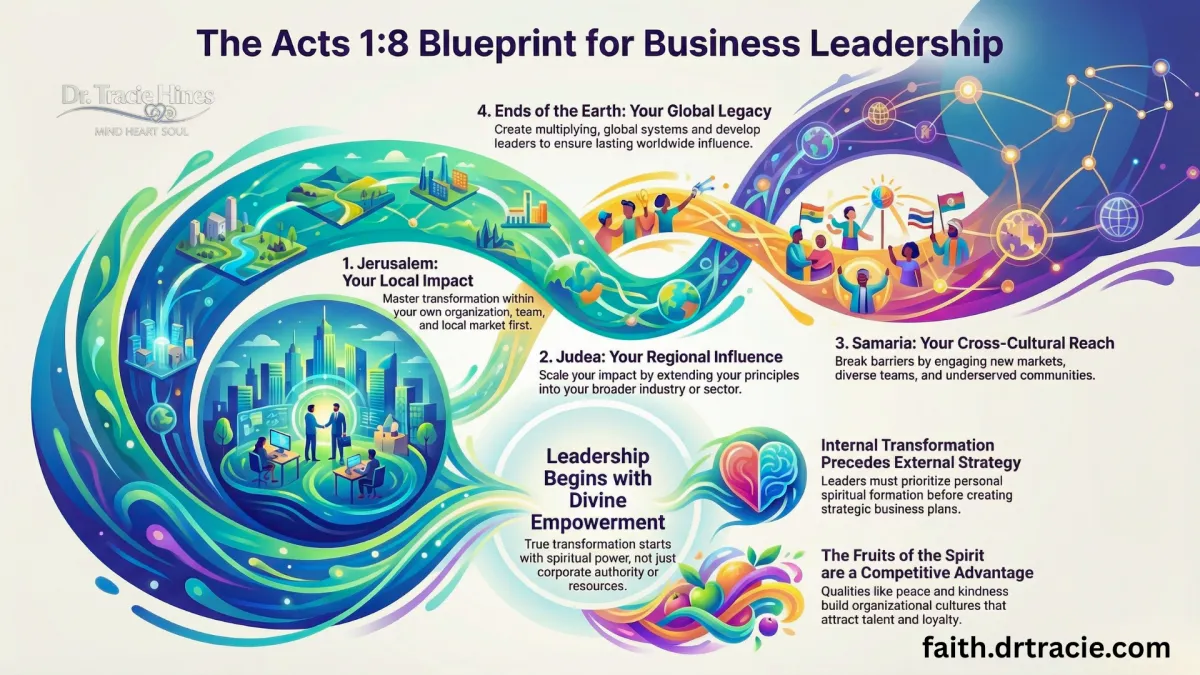
The geographical progression outlined in Acts 1:8—from Jerusalem to Judea and Samaria, and to the ends of the earth—provides more than a missions strategy; it offers a scalable model for business expansion and influence. This divine blueprint teaches us that transformational leadership begins with local impact, expands through regional influence, crosses cultural barriers, and ultimately achieves global significance. For the Christian business leader, this means viewing every business decision through the lens of expanding Kingdom influence, every relationship as an opportunity for discipleship, and every success as a platform for greater service.
As we explore this powerful framework, we'll discover how the integration of Spiritual Intelligence, Emotional Intelligence, and Logical Intelligence—what we call the HolistIQ™ approach—creates leaders who don't just manage organizations but transform lives, communities, and industries. This comprehensive approach to leadership development ensures that Christian business leaders are equipped not just with biblical knowledge but with practical wisdom for navigating the complexities of modern business while maintaining unwavering commitment to Kingdom principles.
The Transformational Leadership Journey
Part 1: The Foundation of Power - Understanding Spirit-Led Transformation
The cornerstone of transformational leadership in the Christian context is the promise of divine empowerment through the Holy Spirit. Acts 1:8 begins with a revolutionary premise: "But you will receive power when the Holy Spirit has come upon you." This isn't motivational rhetoric or positive thinking—it's the promise of supernatural enablement that transforms ordinary business leaders into extraordinary agents of change. For the business leader seeking to integrate faith and work, this power represents the difference between human effort and divine effectiveness.
In the corporate world, we often speak of empowerment in terms of delegation, authority, and resources. However, the empowerment Jesus promises transcends these temporal provisions. It's a spiritual dynamic that affects every aspect of leadership—from decision-making to team building, from vision casting to crisis management. When a business leader operates under the Holy Spirit's power, they access wisdom beyond their experience, courage beyond their natural disposition, and influence beyond their position. This spiritual intelligence becomes the foundation upon which emotional and logical intelligence build, creating a three-dimensional leadership approach that addresses the whole person and the whole organization.
The transformation begins internally before manifesting externally. Just as the disciples were instructed to wait in Jerusalem until they received power from on high, today's Christian business leaders must prioritize spiritual formation before strategic planning. This means establishing disciplines of prayer, meditation on Scripture, and sensitivity to the Holy Spirit's leading in daily business operations. It means recognizing that the boardroom can be a prayer room, that business meetings can be ministry opportunities, and that profit margins can serve Kingdom purposes. The leader who understands this operates from a position of spiritual authority that transcends organizational charts and corporate hierarchies.
Consider how this spiritual empowerment revolutionizes common business challenges. When facing ethical dilemmas, the Spirit-led leader doesn't merely consult compliance manuals but seeks divine wisdom. When navigating conflicts, they don't just apply conflict resolution techniques but minister reconciliation. When casting vision, they don't simply project market trends but discern divine direction. This integration of spiritual intelligence with business acumen creates leaders who can navigate the complexities of modern commerce while maintaining uncompromising integrity and kingdom focus.
The practical implications are profound. A Spirit-empowered leader exhibits characteristics that set them apart in the marketplace: supernatural peace in chaos, inexplicable joy in trials, unexpected wisdom in complexity, and remarkable favor in relationships. These aren't learned behaviors but fruits of the Spirit that manifest when a leader surrenders control to divine guidance. Galatians 5:22-23 describes these fruits—love, joy, peace, patience, kindness, goodness, faithfulness, gentleness, and self-control—as the natural outflow of Spirit-led living. In a business context, these qualities become competitive advantages, creating organizational cultures that attract top talent, inspire customer loyalty, and generate sustainable success.
Part 2: The Strategy of Expansion - From Local to Global Impact
The geographical progression in Acts 1:8—Jerusalem, Judea and Samaria, and the ends of the earth—provides a strategic framework for transformational leaders seeking to expand their influence and impact. This isn't merely about business growth; it's about purposeful expansion that aligns with Kingdom priorities while achieving business objectives. For the Christian business leader, this model offers a blueprint for scaling influence while maintaining mission integrity.
Jerusalem represents your immediate sphere of influence—your current organization, team, and local market. Transformational leadership begins here, in the familiar territory where you have established credibility and relationships. This is where you prototype Kingdom principles, test transformational strategies, and demonstrate the viability of faith-integrated business practices. Your "Jerusalem" is your laboratory for transformation, where you prove that businesses can be both profitable and purposeful, both competitive and compassionate, both successful and servant-hearted. It's where you establish your leadership credibility by producing tangible results while maintaining spiritual integrity.
The Jerusalem phase requires intentional focus on organizational culture transformation. This means implementing biblical principles in practical ways: establishing ethical standards that exceed industry norms, creating compensation structures that reflect Kingdom justice, developing talent with a discipleship mindset, and fostering an environment where faith and work integrate naturally. It means viewing employees not as human resources but as human beings created in God's image, treating customers not as transactions but as relationships, and approaching competitors not as enemies but as iron sharpening iron. The emotional intelligence required here involves understanding the fears, hopes, and motivations of those closest to you, while the logical intelligence applies sound business practices within a biblical framework.
Judea represents regional expansion—extending influence beyond your immediate context to impact your industry, sector, or broader market. This phase challenges leaders to scale their transformational impact while maintaining core values and mission focus. It's where proven principles meet new contexts, where established practices encounter diverse challenges, and where leadership depth is tested by expanded breadth. The Judea phase often involves strategic partnerships, industry influence, and thought leadership that extends your transformational impact beyond organizational boundaries.
In practical terms, the Judea expansion might involve industry speaking engagements where you share transformational leadership principles, strategic alliances with like-minded organizations, or mentoring emerging leaders in your sector. It's where your business becomes a case study for Kingdom impact, where your leadership model influences industry standards, and where your success story inspires others to integrate faith and work. This requires a sophisticated understanding of market dynamics, industry trends, and stakeholder interests—the logical intelligence to navigate complex business ecosystems while maintaining spiritual foundations. The emotional intelligence needed here involves building bridges across organizational boundaries, understanding diverse stakeholder perspectives, and inspiring collective action toward transformational goals.
Samaria represents cross-cultural engagement—breaking through barriers of prejudice, tradition, and comfort to impact those who are different from you. In Jesus's context, Samaria represented the despised "other," the culturally different, the historically separated. For today's business leader, Samaria might represent entering new markets with different cultural norms, serving customer segments previously overlooked, or building diverse teams that reflect Kingdom diversity rather than corporate homogeneity. This phase challenges leaders to confront their biases, expand their perspectives, and embrace the uncomfortable work of cross-cultural transformation.
The Samaria phase demands the highest levels of emotional and spiritual intelligence. It requires humility to learn from those who are different, courage to challenge systemic inequities, and wisdom to navigate cultural sensitivities while maintaining biblical convictions. It might mean adapting business models to serve underserved communities, creating products that meet needs rather than merely generating profits, or establishing operations in challenging contexts where business can be a force for transformation. Leaders in this phase often discover that their greatest growth comes not from what they bring to Samaria but from what Samaria teaches them about God's heart for all people.
The ends of the earth represent global impact—the ultimate expression of transformational leadership that transcends all boundaries to influence the world. This isn't necessarily about multinational corporations or global enterprises; it's about leadership influence that ripples across nations, cultures, and generations. It's about creating business models that can be replicated in different contexts, developing leaders who can carry the transformation forward, and establishing Kingdom enterprises that outlast their founders. The global phase represents the multiplication of transformational impact through systems, structures, and succession that ensure continuity and expansion of Kingdom influence.
Part 3: The Discipleship Imperative - Creating Transformational Cultures
Matthew 28:19-20 provides the methodology for sustaining transformational impact: "Go therefore and make disciples of all nations, baptizing them in the name of the Father and of the Son and of the Holy Spirit, teaching them to observe all that I have commanded you." For the Christian business leader, this Great Commission isn't separate from their business mission—it's integral to it. Transformational leadership isn't just about achieving business success; it's about developing people who can carry transformation forward.
The discipleship model in business context means viewing every employee interaction as a development opportunity, every customer relationship as a chance to serve, and every business decision as a teaching moment. It's about creating organizational cultures that don't just produce products or services but develop people. This approach recognizes that the ultimate measure of leadership success isn't just profitability but the transformation of lives touched by the organization. When leaders embrace this discipleship imperative, they create organizations that become incubators for transformation, launching pads for purpose, and catalysts for Kingdom advancement.
Making disciples in the marketplace requires intentionality that goes beyond traditional training and development programs. It means investing in the whole person—spiritual, emotional, and intellectual development. This might manifest as mentoring programs that address life as well as career, leadership development that includes character formation, or team building that fosters spiritual community alongside professional collaboration. The transformational leader understands that developing people is not a distraction from business objectives but the pathway to achieving them. When people grow, organizations grow. When individuals transform, institutions transform.
The practical application involves creating structured opportunities for growth and development. This includes formal mentoring relationships where senior leaders invest in emerging talent, peer learning groups where iron sharpens iron, and coaching conversations that address performance and purpose. It means celebrating not just business wins but character victories, recognizing not just achievement but growth, and rewarding not just results but faithfulness. The emotional intelligence required here involves understanding individual learning styles, recognizing developmental readiness, and providing support through growth challenges. The logical intelligence applies systematic approaches to development, measuring progress, and ensuring accountability.
Baptizing in the business context represents public identification and commitment to transformational principles. While not literal water baptism, this symbolizes the moment when individuals publicly align with Kingdom values, commit to transformational leadership principles, and identify with a community of faith-integrated business leaders. This might manifest as public declarations of ethical standards, corporate commitments to Kingdom purposes, or individual decisions to integrate faith and work. The baptism metaphor reminds us that transformation involves public commitment, not just private conviction.
Organizations can create "baptismal moments" through various mechanisms: public commitment ceremonies for new leaders, corporate covenant signings that establish Kingdom commitments, or industry declarations that publicly position the organization as faith-integrated. These public identifications serve multiple purposes: they create accountability, inspire others to similar commitments, and establish clear identity in the marketplace. The spiritual intelligence recognizes the power of public declaration, the emotional intelligence manages the vulnerability of public commitment, and the logical intelligence structures these moments for maximum impact and sustainability.
Teaching obedience to Christ's commands in the business environment means translating biblical principles into practical applications that guide daily operations. This isn't about imposing religious practices but about applying Kingdom wisdom to business challenges. It means teaching leaders to love their neighbors (including competitors), to serve rather than be served, to forgive rather than retaliate, and to give rather than hoard. These counter-cultural principles become the distinguishing marks of transformational organizations, setting them apart in marketplaces often characterized by cutthroat competition and self-serving ambition.
The teaching imperative requires systematic approaches to embedding biblical principles throughout the organization. This might include leadership curricula based on biblical wisdom, decision-making frameworks rooted in scriptural principles, or performance metrics that measure Kingdom impact alongside business results. It means creating learning organizations that continuously grow in understanding and applying biblical truth to business challenges. The HolistIQ™ framework becomes particularly valuable here, as it ensures that teaching addresses spiritual formation, emotional development, and logical application in integrated ways that produce holistic transformation.
Certificate
Login to the course to complete the series to earn a certificate. There is NO CHARGE ever. Click the certificate below to log in or register.
Part 4: The Promise of Presence - Sustaining Transformational Leadership
The concluding promise of Matthew 28:20, "And behold, I am with you always, to the end of the age," provides the sustaining power for transformational leadership. This divine presence isn't just comfort in difficulty; it's the ongoing source of wisdom, strength, and direction that enables leaders to maintain transformational impact over time. For the Christian business leader, this promise transforms the isolating experience of leadership into a partnership with the Divine.
The reality of Christ's presence in business leadership manifests in multiple ways. In decision-making moments, it provides wisdom beyond human understanding. In crisis situations, it offers peace that transcends circumstances. In success, it maintains humility and perspective. In failure, it provides comfort and hope. This presence isn't passive but active, not distant but intimate, not occasional but constant. Leaders who cultivate awareness of this presence operate from a fundamentally different paradigm than those who rely solely on human resources and wisdom.
Practicing the presence in daily business operations requires intentional disciplines that maintain spiritual sensitivity amid marketplace demands. This includes beginning each day with prayer and Scripture meditation, practicing momentary prayers throughout the day, and maintaining spiritual accountability relationships that keep leaders grounded. It means creating spaces for spiritual reflection even in busy schedules, establishing rhythms of sabbath even in 24/7 business cycles, and maintaining spiritual disciplines even when traveling or under pressure. The spiritual intelligence here involves discerning God's presence and voice amid the noise of the marketplace.
The emotional dimensions of Christ's presence address the unique challenges of leadership loneliness, pressure, and responsibility. Leaders often describe their role as isolating, with few people understanding the weight of their decisions or the complexity of their challenges. The promise of divine presence means leaders are never truly alone, never without counsel, never without comfort. This emotional support enables leaders to maintain resilience in adversity, hope in uncertainty, and joy in difficulty. It provides the emotional intelligence to lead with empathy, understanding that others also need the comfort and strength that comes from recognizing divine presence in their work.
The logical application of divine presence involves structuring organizational practices that acknowledge and invite God's presence into business operations. This might include beginning meetings with prayer, establishing decision-making processes that include spiritual discernment, or creating physical spaces that remind people of spiritual realities. It means developing business strategies that assume divine partnership, setting goals that require divine intervention, and measuring success by Kingdom standards alongside business metrics. The logical intelligence here involves systematizing spiritual practices in ways that enhance rather than hinder business operations.
The sustaining power of divine presence becomes particularly crucial during seasons of challenge, change, or growth. When market conditions threaten stability, when competition threatens survival, when internal conflicts threaten unity, the presence of Christ provides the stability, wisdom, and peace needed to navigate turbulent waters. Leaders who have learned to rely on this presence exhibit remarkable resilience, maintaining effectiveness even when external circumstances would suggest otherwise. They demonstrate what Paul described in Philippians 4:13: "I can do all things through Christ who strengthens me"—not as a blank check for success but as assurance of sufficiency for whatever God calls them to do.
Part 5: Integration and Implementation - Making It Real
The transformation from traditional business leadership to Spirit-empowered transformational leadership doesn't happen overnight. It requires intentional integration of biblical principles with business practices, spiritual disciplines with strategic planning, and Kingdom purposes with corporate objectives. This integration challenges the false dichotomy between sacred and secular, demonstrating that all of life—including business—can be sacred when submitted to God's purposes.
The integration process begins with personal transformation. Leaders cannot give what they don't possess, cannot lead where they haven't gone, cannot inspire what they don't embody. This means prioritizing personal spiritual formation as the foundation for professional transformation. It requires honest assessment of current spiritual health, identification of growth areas, and commitment to disciplines that foster spiritual maturity. This personal transformation becomes the wellspring from which organizational transformation flows. Leaders who have experienced the transforming power of the Holy Spirit in their own lives become catalysts for transformation in their organizations.
The practical steps for personal integration include establishing non-negotiable spiritual disciplines: daily time in Scripture and prayer, weekly sabbath rest, regular spiritual direction or coaching, and consistent participation in spiritual community. It means addressing character issues that might limit leadership effectiveness, healing from past wounds that might distort leadership perspectives, and breaking free from limiting beliefs that might constrain leadership impact. The HolistIQ™ framework supports this integration by ensuring that spiritual growth is accompanied by emotional healing and logical understanding, creating balanced leaders who can navigate complex business challenges while maintaining spiritual integrity.
Organizational integration requires systematic approaches to embedding Kingdom principles throughout corporate culture, strategies, and operations. This begins with clarifying organizational purpose beyond profit, establishing values rooted in biblical truth, and creating vision that encompasses both business success and Kingdom impact. It means aligning organizational structures with biblical principles of stewardship, justice, and service. This might involve restructuring compensation to reflect biblical concepts of fairness, reorganizing operations to prioritize people over profits, or redirecting resources to serve Kingdom purposes alongside business objectives.
The implementation strategy should be both comprehensive and gradual, recognizing that transformation takes time and that different stakeholders will embrace change at different rates. This might involve pilot programs that demonstrate the viability of faith-integrated practices, gradual expansion of Kingdom initiatives as they prove successful, and patient cultivation of cultural change that allows deep transformation rather than surface compliance. The emotional intelligence here involves managing the anxiety that change produces, building coalition support for transformation, and celebrating early wins that build momentum for continued change.
Creating accountability structures ensures that transformational commitments translate into sustained action. This includes establishing metrics that measure Kingdom impact alongside business results, creating governance structures that maintain mission focus, and developing feedback mechanisms that ensure continuous alignment with transformational purposes. It means building boards that understand and support faith-integration, developing leadership teams committed to transformation, and fostering cultures where accountability is viewed as supportive rather than punitive.
The accountability framework should address all three dimensions of the HolistIQ™ model. Spiritual accountability ensures leaders maintain vital connection with God and alignment with biblical principles. Emotional accountability addresses the relational and cultural dimensions of transformation, ensuring that leaders maintain healthy relationships and foster positive organizational climates. Logical accountability focuses on business results and strategic execution, ensuring that transformation produces tangible outcomes that validate the integration of faith and work.
The Ongoing Journey of Transformational Leadership
As we conclude this exploration of Spirit-led transformational leadership, it's crucial to recognize that this is not a destination but a journey. The Acts 1:8 model doesn't promise immediate global impact but provides a progression that unfolds over time. The Great Commission doesn't guarantee easy success but promises divine presence through every challenge. For the Christian business leader, embracing transformational leadership means committing to a lifelong journey of growth, impact, and multiplication that extends far beyond quarterly earnings or annual objectives.
The journey ahead will require courage to challenge status quo business practices that conflict with Kingdom principles. It will demand wisdom to navigate the tensions between marketplace demands and biblical mandates. It will necessitate perseverance when transformation seems slow, opposition seems strong, or results seem distant. Yet the same Holy Spirit who empowered a small group of disciples to transform the Roman Empire is available to empower today's business leaders to transform their industries, markets, and communities. The promise of power hasn't diminished, the commission hasn't changed, and the presence hasn't departed.
The multiplication effect of transformational leadership extends beyond individual impact to generational influence. Leaders who embrace this model don't just build successful businesses; they establish Kingdom enterprises that continue transforming lives long after the founders have departed. They create leadership pipelines that produce successive generations of transformational leaders. They establish organizational cultures that perpetuate Kingdom values across decades and even centuries. This is the ultimate expression of transformational leadership—influence that transcends temporal success to achieve eternal significance.
For the business leader reading this, the invitation is clear: Will you accept the call to transformational leadership? Will you allow the Holy Spirit to empower your business endeavors? Will you embrace the comprehensive scope of influence from your Jerusalem to the ends of the earth? Will you commit to making disciples in the marketplace, teaching Kingdom principles through business practices, and relying on Christ's presence through every challenge? The marketplace desperately needs leaders who operate from this paradigm—leaders who understand that business can be ministry, that profits can serve purposes, and that organizations can be instruments of transformation.
The practical next steps are within reach. Begin with personal spiritual renewal, seeking fresh filling of the Holy Spirit for the challenges ahead. Assess your current "Jerusalem"—your immediate sphere of influence—and identify specific opportunities for transformational impact. Develop a strategic plan for expanding influence through your Judea, Samaria, and to the ends of the earth, recognizing that each phase requires different strategies and capabilities. Commit to the discipleship imperative, viewing every relationship as an opportunity for development and every interaction as a chance for transformation. Most importantly, rest in the promise of Christ's presence, knowing that you don't journey alone but in partnership with the One who has all authority in heaven and earth.
Your Transformational Leadership Journey Begins Now
The principles we've explored aren't merely theoretical concepts but practical frameworks for real transformation. As you consider implementing these principles in your leadership context, remember that transformation begins with a single step of obedience. Whether you're leading a small team or a large corporation, whether you're just beginning your leadership journey or have decades of experience, the invitation to Spirit-empowered transformational leadership is extended to you.
Take the first step today. Download our comprehensive Transformational Leadership Toolkit, which includes practical assessments, implementation guides, and strategic planning templates designed specifically for Christian business leaders. This resource will help you evaluate your current leadership approach, identify specific opportunities for faith-integration, and develop actionable plans for transformational impact. Visit portal.drtracie.com to access this free resource and join the HEARTfelt Connections Community, where transformational leaders gather to support, encourage, and equip one another for Kingdom impact in the marketplace.
Remember, you're not alone in this journey. The HEARTfelt Connections Community provides ongoing support, practical resources, and meaningful connections with other Christian business leaders committed to transformational leadership. Together, we're proving that businesses can be both profitable and purposeful, that leaders can be both successful and servant-hearted, and that organizations can achieve both marketplace success and Kingdom significance. Join us as we transform the marketplace, one leader, one organization, and one industry at a time.
The marketplace is waiting for leaders who will demonstrate a different way—leaders who operate from divine empowerment rather than human striving, who expand influence for Kingdom purposes rather than personal gain, who develop people rather than just managing resources, and who rely on divine presence rather than human wisdom alone. You can be that leader. The same Spirit who empowered the early church to transform their world is available to empower you to transform yours. The question isn't whether God can use you in transformational leadership—He can. The question is whether you will make yourself available for Him to do so.
Contact Information
DOWNLOAD ALL MATERIALS: CLICK HERE
The materials downloaded can be modified and rebranded.
DOWNLOAD NOTES: CLICK HERE
JOIN MAILING LIST: Click HERE
PORTAL LOGIN: https://portal.drtracie.com
MEET DR. TRACIE: https://drtracie.com
SEND EMAIL: [email protected]
HE GETS US: https://hegetsus.com
Acknowledge #sin and #repent in #leadership / Join the #journey to #freedom in #Christ / Embracing #authenticity and openness in your #leadership / #Transformative #power of #confession / Developing a #culture of repentance / #Jesus / #God / #drtracie #drtraciehines #drtracielashley #aceirt #heartfeltintelligence #kingdomshepherd #johnmaxwell #russellbrunson #myrongolden #Jesus #God #GrantCardone #DanGoldman #mannachurch #manna #hegetsus #DRTRACIE #DRTRACIEHINES #DRTRACIELASHLEY


